
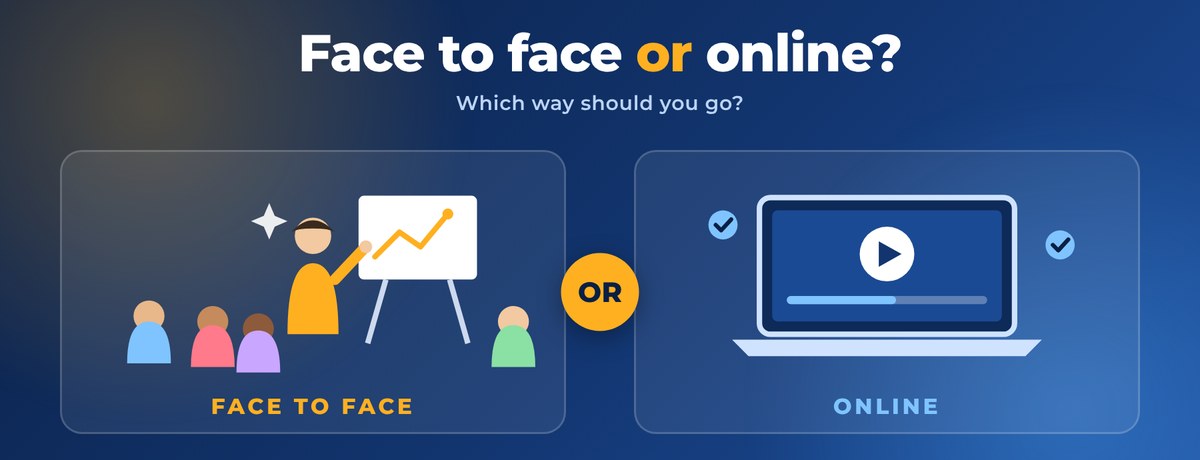
It’s a question I get asked more and more: should we put our training online, or keep it face to face? And every time, I give the same slightly annoying answer. It depends. Not because I’m dodging the question, but because anyone who gives you a one-line answer, either way, probably isn’t thinking about your business. They’re thinking about their product.
So let me be straight about where I stand, because I think it matters.
Online learning has come a long way
I’m a strong believer in it. Online learning has come a very long way, and it’s getting better all the time. Done well, it’s consistent, it’s available whenever people need it, they can work at their own pace, and you can see exactly who has completed what. There are subjects and topics that suit that way of learning brilliantly.
We run our own online platform here at T8, with more than 50 courses on it, and I’ve completed some of them myself. I wouldn’t ask anyone to sit something I hadn’t sat through first.
But not all subjects. And not for every message.
Start with the questions, not the price list
Before you invest in any training, in either format, there are some honest questions worth sitting down with. Things like:
- What am I actually trying to deliver? Information, a skill, or a change in behaviour?
- What message do I want to get across, and how hard does it need to land?
- Will this prove competency, or will it only prove that someone clicked through to the end?
- Who is it aimed at? What’s the demographic, and how do those people best take information in?
- Is it job-specific or industry-specific?
- Am I trying to build a culture, and what will this do to the culture I already have?
- What are the hard-hitting messages people need to see, and feel, not just read?
And there are many, many more besides. That list is where the decision really gets made. Not in the brochure.
Ask the people who will actually sit it
If you only do one thing from this blog, make it this. Don’t just ask managers and senior people what the training needs to be. Share the load. Speak to the people who will be expected to complete it, and to learn something from it.
They’re the ones who will give you the true answers. What they already know. What they don’t. What makes them switch off. What they’ve seen go wrong on the shop floor that never made it into a report. A few honest conversations at the start can save you from an expensive mistake at the end.
The square peg problem
Put a square peg in a round hole and you can hammer all day long. It isn’t going in, and you’ll damage both the peg and the hole. Training is exactly the same.
Will online training stop all your problems and prevent every accident? In truth, no. And neither will full-time face to face training. Neither format is a magic wand. They’re tools, and the skill is in choosing the right one for the job in front of you.
Where online does a cracking job
Health and safety is a subject that needs careful planning and a proper scope of work. Regulatory training, for example, the rules and regulations, what the law expects of you, how to carry out an audit, is perfect online, if it’s right for the people taking it. The content needs to be accurate, it needs to be the same for everybody, and people often want to go back and check something later. Online does all of that very well.
Where nothing beats a person in the room
But if you want to get a strong message across, the real consequences of not acting, the hard-hitting stuff that people need to feel as well as understand, then I don’t believe anything beats face to face training from a qualified, experienced trainer. Someone who can tell the story. Someone who can read the room and speak to your people the way they best receive information.
Tone and delivery are magic dust. An online course can’t give you that.
An online course is set as it is set. It can’t change with the room. It can’t see the person at the back who stopped listening ten minutes ago, or the one whose face just dropped because the story sounded a little too close to home. It can’t spot whether the message has landed. It does exactly what it says on the tin: it delivers the information. For plenty of subjects, that is precisely what you want. But information and impact are not the same thing.
Culture is made by people
Everything about culture is people. How they speak to each other, what they walk past, what they stop and challenge. Cultural change is made by people and it involves people, so if that’s what you’re trying to achieve, deliver the training with people. Put them in a room together. Let them hear each other’s questions. Let them see that you mean it.
Where AI and digital fit in
I’d be a hypocrite if I wasn’t honest about my own working life here. What AI and digital platforms can do seems to change every week, and every month there’s something new. They help me massively in my role. I use them to collect information, to create resources, and to check facts and figures. I’ll keep using them.
But after that, it comes down to how I deliver it, and that’s where my experience comes in. I’ve got thirty years’ worth of examples to give, and thirty years of mistakes to share so that other people don’t have to make the same ones. A tool can help me prepare. It can’t stand in front of your team and tell them a story because it lived it. And I have a genuine passion for training and for health and safety. That’s why I do what I do.
Sitting on both sides of it
I don’t just offer these things, I do them. I’ve completed online courses myself. And I also sit in on courses delivered by real people with real experience. Those are the ones that really focus my mind. When someone shares what they’ve seen and what they’ve been through, I find myself connecting it to my own experience, and that overlap is where it sticks. Both have taught me something, in different ways. That’s really the whole point.
So, which way should you go?
There is no definitive answer, other than this: don’t rush into one without the leg work. Before you decide:
- Find out what’s actually needed, rather than what’s assumed.
- Think about what would suit your whole workforce, not just certain departments.
- Be clear about what you’re trying to build.
- Know what your message to your people is, then pick the format that carries it best.
For some of your training, that will be online. For some, it will be face to face. For plenty, it will be a mixture of both. What matters is that it was a decision and not a default.
If you’d like to talk it through, I’m always happy to. You can have a look at our online course library, browse the full course list, or just get in touch and we’ll work out what really suits your people.