
When I inspect fire doors, I'm rarely surprised any more. The same failures turn up in building after building, and nearly all of them are easy to fix, if somebody looks before the day it matters.
A fire door isn't just a door. It's a tested assembly of leaf, frame, hinges, seals, closer and latch, built to hold back fire and smoke for a set period so that people can get out and the fire service can get in. Get one part wrong and the whole thing can fail. Here's what I find most often.
Hinges that were never meant for the job
It's no good having a fire door if the hardware isn't suitable for the job. I regularly find ordinary, non-fire-rated hinges on doors that are supposed to protect people. They look fine. They open and close fine. But hinges that can't take the heat can fail in a fire, and when a hinge goes, the door goes with it. A door that fails in service like that could be catastrophic, because nobody finds out until the one day it matters.
It's not a rare problem either. Industry coverage of the Fire Door Inspection Scheme's findings in 2015 reported that surveys had found nearly a quarter of doors fitted with unsuitable hinges.
Gaps, slipped doors and doors hung wrong
Doors drop. Frames get knocked. Someone rehangs a door and doesn't know what they're aiming for. Either way, I find gaps between the door and the frame, or between the door and the floor, that would never pass an inspection.
On most fire doors the gap around the edges needs to be tight, in the region of 2 to 4mm (about the thickness of a £1 coin), with a little more allowed under the door, generally no more than around 8mm. The exact figure depends on the certification for that particular door. The intumescent seals in the door or frame are designed to swell in the heat and close the gap. If the gap is too big, or the seal is missing, cut short or painted over, they can't do their job.
If you're relying on one of these doors and the gaps are too big, the consequences could be dire. The same 2015 coverage reported that over 61% of the doors inspected had problems with their fire or smoke seals.
The most common of all: doors wedged open
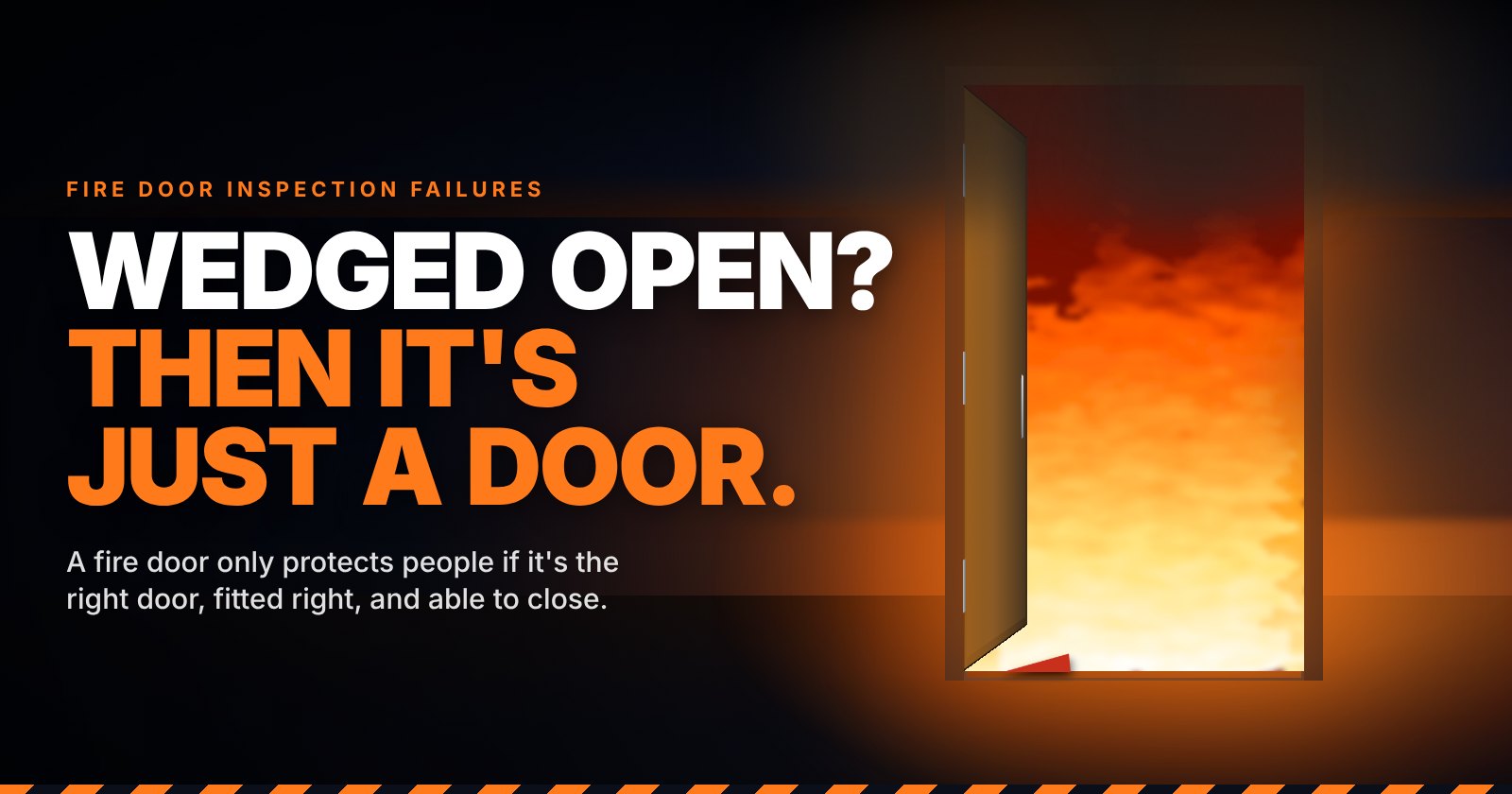
The single most common failure I find is also the simplest. Fire doors wedged open, with a wedge, a fire extinguisher, a bin or a chair, because it's easier to get through or because the room gets warm and stuffy. I understand why people do it. But a door that's wedged open isn't a fire door. It's an open gap in your fire protection with a fire door sign on it.
If you feel the need to have a fire door open, fit a proper door retainer that releases and lets the door close automatically when the fire alarm sounds. Then check it. The door needs enough closing strength to shut properly once it's released, and the catch has to work. Otherwise it's still not fit for purpose.
Closers that don't actually close the door
Check your door closers. Is the closer actually pushing the door fully closed, every time? Or does it stick somewhere? I find closers that aren't strong enough to finish the job, doors that catch on the floor and stop, doors that rub on the frame and don't close properly, and latches that don't engage. All of these fail a fire door inspection, and all of them are dangerous if the worst ever happened.
You can test it in half a minute. Open the door, let go and watch. If it doesn't close fully and latch on its own, it has failed.
The right door, in the right place, with the right rating
Do you have fire doors where fire doors should be? Is each one the correct rating for where it is, for example 30 minutes or 60 minutes? Do you know how to check what should be there, and do you have the right protection in place?
Then there's the question I'm asked less often than I'd like. Should the door be integrity only, or integrity and insulation, and do you know the difference? Integrity is a door's ability to stop flames and hot gases passing through it. Insulation is its ability to limit how much heat is transferred to the far side. An EI30 door gives you both for 30 minutes. An E30 door gives you integrity only. Glazed doors and screens are a common example of where the difference matters. Which one you need isn't a guess. It comes from your fire risk assessment and the fire strategy for the building.
One honest caveat: those ratings describe how a door performs in a standardised fire test. They aren't a promise of how long it will last in a real fire. That's one more reason to keep every part of the door in the condition it was tested in.
A quick look you can do today
- Is it being held open with anything other than a proper alarm-linked retainer?
- Does it close fully and latch by itself when you let go?
- Are the gaps even all the way round, and no bigger than a few millimetres?
- Are the seals all there, undamaged and not painted over?
- Are all the hinges present, fire-rated, and fixed with all their screws?
- Is it the right rating for where it is, and has anyone ever checked?
This is a look, not an inspection. A competent person needs to carry out the real thing.
Why it matters: the numbers
I wanted to put some figures alongside what I see on site, so I went to the Home Office and other published sources. These are the ones I'd stand behind.
The Home Office costing also reflects what I see in businesses. For fires in non-dwelling buildings it assumes the wider damage is 133% of the direct damage, “to account for the greater potential for business impacts”. In other words, the fire is only the start of the bill.
Can a business survive a fire?
I've said for years that more than half of businesses don't survive a major fire. When I went looking for a hard UK figure to back that up, I couldn't find one I'd put my name to. The numbers depend on who's counting and what they count. The figure quoted most often is attributed to the US Federal Emergency Management Agency, which says 40 to 60 per cent of small businesses never reopen after a disaster. That covers disasters in general rather than fire alone, and it's American, so I'd treat it as a warning rather than a UK fire statistic.
What I can say from what I've seen is that it is extremely difficult for a business to come back from a serious fire. Yes, insurance pays out. But not always quickly enough, and you can't provide the service until you get paid, so customers go elsewhere. And the insurance itself can fall short. Research by the Chartered Institute of Loss Adjusters, reported by the Fire Protection Association, found 43% of business interruption policies were under-insured by an average of 53%.
It isn't worth thinking “I should have”. By then it's too late.
What fire doors do, and what they don't
Fire doors won't stop you having a fire. What they do is protect people and property for a period of time while the fire service tackles the blaze. The government's guidance on fire doors in blocks of flats puts it plainly: “Fire-resisting doors (fire doors) are one of the most important measures to safeguard the means of escape from fire.” That guidance is written for residential blocks, but the principle holds in any building.
What the law expects
In England, the Regulatory Reform (Fire Safety) Order 2005 applies to all buildings other than domestic housing. The responsible person, usually the owner, manager or employer, has to manage fire risk, and fire doors need to be part of the fire risk assessment. Industry guidance from the British Woodworking Federation suggests periodic checks at least every six months, with full inspections done by competent people. Failure to comply can put property and lives at risk and is likely to lead to prosecution.
For blocks of flats where the top storey is more than 11 metres above ground level, the Fire Safety (England) Regulations 2022 go further. The responsible person has to check fire doors in communal areas at least every three months, and use best endeavours to check flat entrance doors at least every 12 months.
But the law isn't the reason
If you own business premises or a public building, the law says your fire doors should be inspected. For me, my conscience would tell me exactly the same. Fire protection is there to save lives first, then the building, then your business.
I have seen what a fire can do to a business on a number of occasions. The devastation it causes, the clean-up crews, the investigations that follow. For me this hits home because it's people's right to survive a day at work, and to be able to plan for tomorrow, next week and next year with their family and friends. It's our job to protect the people who work in our businesses and anybody who comes into contact with them. Even without quoting the law, it should be the first thing on our agenda every single day.
Protect your people. Protect your business. Get your doors checked, and appoint a responsible person to check them periodically.
Sources
- Home Office, Economic and social cost of fire (figures for year ending March 2020).
- Home Office, Fire and rescue incident statistics, year ending March 2025.
- Construction Enquirer (14 May 2015), Fire Door Inspection Scheme findings, and The Construction Index, Contractors sleepwalking into danger over fire doors.
- Fire Protection Association, A small price (Chartered Institute of Loss Adjusters research on business interruption cover).
- City of Miami, Business recovery after a hurricane, citing FEMA (40 to 60 per cent of small businesses never reopen after a disaster).
- HM Government, Fire Safety (England) Regulations 2022: fire door guidance.
- British Woodworking Federation, Fact Card 2: The Fire Safety Order.
- Fire Risk Assessment Network, Common fire door defects (gap tolerances), and OAG, fire glazing glossary (integrity and insulation).
The rules above are those that apply in England. Requirements differ in Wales, Scotland and Northern Ireland. This article is general information, not a substitute for a fire risk assessment of your own premises.